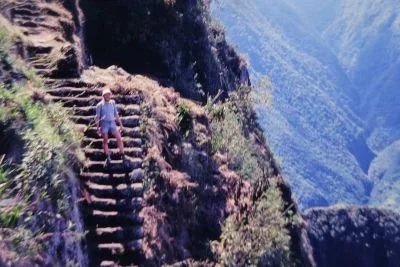
Colombia - San Andrés de Pisimbalá
Viernes 16 Febrero 1979 - Popayan —> San Andres de Pisimbala
The road to San Andrés de Pisimbalá
Suzi & I woke ourselves up with an alarm clock (kindly lent by the nice man of Gualcala) at 4:20 am in order to catch a 5 am bus to San Andres de Pisimbala. We managed to down cafe con leche before the bus took off in the dark. The fare was 108 pesos, on a very comfortable and uncrowded autobus. What a pleasure it is to travel on such buses where one doesn’t have to fight & keep secure one’s seat!
The road was narrow & dirt/shingle and as the sky brightened I could see we were travelling through some beautiful green pastures & mountain valleys. There were healthy looking dairy cows on the paddocks and a beautiful landscape of trees dotted over the fields.
The bus stopped about 7 am at a roadside cafe where just about everybody got out to have some coffee & bread. I had cafe tinto - a small cup of sweet black coffee, and pan de queso, a very tasty cheese bread.
It continued on towards Inza, through further spectacular scenery of towering green cliffs & deep valleys. This is really Andes country & it feels good to be here at last. Past Inza, the bus stopped at a sign pointing to San Andres about 9:30 am. We walked for maybe 5 km, stopping for hugos de mora (blackberry juice), and met Loid from Oaklahoma walking along the road.
A Colombian who was on the bus with us, invited the three of us to stay in his house so we walked up to the puebla de San Andres & to his place. He said we could pay him as we like for the room. We arrived very hot & sweaty and were given some guava hugo to refreshen us.
Burial chambers of Alto de San Andrés
I washed some clothes and then went to eat with Suzi. Had an enormous dinner of soup, and rice, veges etc. Suzi and I went for a wander later down a valley, across a bamboo bridge and up a hill to Alto de San Andres, where we explored about 9 caves.
A guide led us down each one & lit matches in the places of most interest. Saw some remarkable markings on the walls & pilars of the caves. One cave had a beautiful design of red & black diamond pattern, as if off a modern wallpaper. There were drawings of human beings & faces in the stone & clay walls.
The caves apparently were solely burial chambers. The floor of each had a little pit where bones were found. There were also some connecting tunnels between caves.
From the top of the hill we could view the whole of the San Andres valley & township perched on the slopes. A beautiful canopy of trees, red in flower, filled the valley.
Other obvious plants were banana trees & bamboo groves. As we walked back it was like coming through an enchanted forest. The whole area is so peaceful & adorned with nature’s beauty. Muy tranquilo.
Met a Venezulean guy &, his Spanish speaking English wife? in the restaurante - discussed Colombia & Venezula, etc. talked with the children at the house, showed them my C.American almanac.
Watched the coffee bean husk washing off process. The guy who owns the house apparently makes his living from growing coffee.
* Sabado 17 Febrero * Saturday 17th February, 1979
Tierradentro - the inner land
I have entered my 25th year in one of the most peaceful and amiable environments I have ever been in: SAN ANDRES DE PISIMBALA, tucked in a beautiful colourful valley where hummingbirds and butterflies dance among the flowers of the trees, surrounded by inspiring misty mountains which bare their giant green rock outcrops, like shoulders and knees.
The valley is painted with huge trees covered in red flowers, which are so bright and crimson when one is close to them. The amazing thing is that these trees flower for only 15 days of the year, and that time is now, the very time I should arrive for my birthday. The valley must never look more beautiful.
The area is called Tierradentro meaning ‘the inner land’ - or a very inaccessible place as it once was.
Birthday cakes
I awoke to discover a little parcel beside my bed, placed by my good friend Suzi. She had given me a very thoughtful little gift - a pack of cards made in Colombia, inside a cloth bag she had sewn herself.
The next wave of kindness came when my ‘adopted’ family came into the room with not one, but two glorious birthday cakes covered in icing.
The elder daughter had specially gone to the market to buy the ingredients, and had baked the cakes specially for me, during the day. I cut off slices and shared them around with everybody.
Lloyd, Susan & myself caught the local bus to Inza at 9 am. Saturday is market day in Inza, so we made the trip to check out the activity. This was a real market for the people, an exchange of fruits and vegetables, animals, and weavings.
I spied some beautiful woolen ponchos but learnt that they were made in Ecuador. Took some photographs using my 135mm lens, and then we returned on the roof of another bus. The mountain scenery is so magnificent that we wanted to have a full, unimpeded view from the top.
Suzi and I explored the Museo at San Andres. They have an interesting collection of funeral pots found in the caves with some well preserved designs on them. I copied one into this book.
Upstairs, were some ethological artifacts of the way of life of the Indian people here; A huge wooden machine, with wooden cogs, for squeezing the juice of sugar cane; drums & clothes. Suzi was given some coco leaves to chew, and some white powdery rock to mix in with her salivary gunk. The guide was very alert & keen to point out everything to us.
The tombs of Alto del Aguacate
After the museum we began a 1½ hr climb to El Aguacate, the site of numerous caves on top of a high ridge, overlooking the valley of San Andres, and on the other side, Inza. We both enjoyed the climb. The air was so clean & fresh, yet not cold.
The most important cave had a little roof structure over it. I went down armed with flashlight & candle & sat for a few minutes, observing some interesting designs of humanoids and/or insects.
One creature had hands with 3 fingers, 4 toed feet and a tail, with a human? face. There were also diamond patterns & snake designs.
Suzi & I carried on along the ridge, past numerous caves. We were guided down a smaller ridge by a little boy whose house was just down the hill. He ran down the hill as if he could fly. We walked for a few more hours, past some hillsides & crops. Arrived back at our home about 5:30 pm.
In the evening we ate at the restaurant just down the hill from our house and met again with Venezulean couple. Suzi had bought me a bottle of Spanish wine for my birthday, which we shared amongst the 5 of us. Unfortunately it didn’t go far. Dinner was steak, rice, tomato & fried banana. We played cards & chatted for the rest of the evening.
And so ended the most excellent birthday I’ve ever enjoyed. Being with people who cared to make it special for me, made the difference.
Domingo 18 Febrero San Andres de Pisimbala
The caves of Alto de Segovia
Had breakfast with Suzi, Lloyd & the Venezueleans. Afterwards we travelled with them down the hill in their Toyota landcruiser & climbed up a hill to Segovia. There all 5 of us explored some of the underground caves. Some had electric light bulbs lying on the ground to illuminate the faces & patterns. The designs were all very similar. Triangular heads on top of pillars, and diamond wallpaper like patterns.
After fooling around with Om sounds & running down & up several caves we returned to the village. The Venezuleans offered Suzi & I rides to San Augustin. Suzi couldn’t resist the offer, but I decided to stay a bit longer in San Andres. She packed quickly & was off - a rather sad moment for us pero we will join each other further along the way, I’m sure.
It is now just Lloyd & I sharing the room. Rested in the afternoon. Wrote up my diary. Went for a short walk up to see the valley of Pisimbala.
On the way I talked to some Indian ladies. They offered me ‘chauca’, some very potent alcoholic drink, from which they themselves were already bombed. Walked along with an Indian man who lived far away on the other side of the valley. Tomorrow I will walk further into the region.
Had dinner with Lloyd, and a bunch of other gringos at the restaurante. Two dutch people, two french guys & very slick slick French lady! Had an enjoyable meal & conversation, at times very humorous, esp. as a drunken Colombiano tryed to talk to all of us.
He shared his ‘chauca’ with us tambien a taste rather like oozo in N.Z. Talked with the family back at the house. I gave away four of my tikis to them & some N.Z. coins.
Lunes 19 Febrero 1979 San Andres —> Pisimbala —> Tumbichucue —> San Andres
The kindness of strangers
Today I went for a 9 hour walk. (Doesn’t that sound impressive?) After breakfast I departed with day pack and walked off towards Pisimbala, further up this valley. I ran into the boy from my family and he guided me on, first passing the little school where a bunch of tiny tots were having their lessons on the porch.
Our next stop was at a house built of mud, plastered over a wooden frame. The man showed me inside his very dark home. His wife was sitting in a little room separated from the main living area - it was the kitchen. Outside the pigs were drinking from a stone trough - a lipped bowl carved entirely out of a giant rock.
I also saw his sugar cane squeezing machine - some metal gears which were turned by a long wooden lever on top. We stopped at a house where they offered me some ‘chichi’ drink - it tasted like fermented sugar cane juice & was excellent.
We walked off through coffee and banana tree plantations, up a track to the crest of a big hill. Here we sat and looked over the beautiful valley of Pisimbala. I changed into my shorts at this stage, getting prepared for a walk of many more hours.
The boy left me to have his cena & I carried on alone into the mountains. I passed a few Indians on the trail, some with horses. I kept a good eye on where I was coming from, remembering the shape of the hills around the valley. so that I would easily recognise the area when or if I returned by a far & different trail.
I walked happily on around bush clad cliffs, scattering butterflies which were dining on horseshit, and listening to the sounds of birds, & bees & streams. I stopped at most streams for a cold wash & drink.
Some water flows had been tapped with bamboo shoots, creating a little water drop to facilitate the ladies who come to fetch their water for the house. I wandered off on a path which came to a dead end, but at a little house.
The man there immediately ordered his children to bring me a seat & fetch some fruit from the trees. I plonked myself down on a little piece of wood about 6” above the ground, and was handed 3 green apricots. They were quite digestible however, and very much appreciated. I reciprocated by giving him the cake of chocolate that I had bought for the walk. I thought it was the eating variety but it wasn’t, as I found out much to my distaste.
He then invited me into his casa, out of the sun, where I sat in the smoke of his indoor fire. I had been watching the smoke come out of his roof, which had a small gap to release the smoke.
Much to my surprise he produced an egg the pot of boiling water over the fire, and handed it to me on a plastic plate, with side dipper of salt. I carefully devoured the egg, muchas graciased him & left for further afield.
A very kind person who was willing to give what little he had, to help a stranger that just walked up to his house.
I climbed to the top of a pass that led to another big valley, with another village or group or group of houses scattered in close proximity. Down I went, passing more streams & little mud houses.
At about 1:30 pm I rested, taking my shoes & socks off & finishing off the last of the apricots. I walked back down a grassy slope (grazing area for the ‘wild’ - correction - free - horses) and plunged my feet into the very cold river.
My feet felt so good to have the stimulation of the soft grass under them, plus the air around. It was as if with every step they received a gentle massage.
As I walked along in this way I theorised that perhaps man’s ills are caused by lack of stimulation of the nerve endings in the feet, because he always shields them with shoes. I recalled how important the feet are in healing massage because every part of the body has its nerve ending & control point there.
What more natural way to walk than to go barefoot?
After so much walking it was good to give my feet some attention. I chilled them in the ice-cold river water & walked on the sun hot rocks, dryed them in the sun & gently massaged them.
I had walked for 6 hours before deciding to turn around, but it turned out the return journey was only 3 hours. So I arrived back at 5:15 pm. Stopped on the way at the friendly house with the chici & drank another 23 cupfulls.
Had comida of potatoes, rice & platanos, with a tomato slice. Played with the children. Sat on the porch & chatted. I think my Spanish is improving, especially here.
Met some Colombians in the restaurant who have a finca down the road. One is a doctor & el habla buena English. Si!
Martes 20 Febrero, 1979 San Andres de Pisimbala
The statues of El Tablón
Wrote a postcard to Vicky Newick in very small writing over the breakfast table, whilst having cafe & fried platanos on the house.
Walked up the hill to look at las estatuas del Tablon. Talked to the caretaker there, who was trimming the grass & raking the leaves. He pointed out the various parts of the statues, such as their toes (cinco), bracelets, skirts, etc.
The statues were grouped around in a semi-circle of sorts, but the majority faced the west, towards the setting sun. One rock even represented a serpent, its head & eyes clearly distinguishable.
I carefully aligned ‘the love trees’ for a photograph & also captured a wild orchid growing off the side of a tree. Had a mayacuya hugo con leche, bought an archaeological guide to San Agustin & Tierradentro for 50 pesos and climbed back up to Segovia tombas.
This time I saw the tomb with its burial pots intact - a fantasic sight - one reserved normally only for achaelogical diggers. I returned to a deep tomb and copied the wall design and a face from another.
I talked there with an intelligent sort of bloke inspecting las tumbas - he was very interested in me when he saw my drawing of the salamander & realised my intense interest in the area.
I walked back through fields of coffee, clambering over rocks, prickly trees and in the beginning passing a few homes. After coming down the hill from El Tablon I was called to by a little girl wanting me to buy a gaseosa. So for 5 pesos I drank a manzana juice & talked to her about her house, her animals & her patches of materials.
Ate again at the restaurant down the hill & around my table happened to sit four people from Belgium. Anna & Jacque, & Anna’s Mum & Dad. Anna & Jacque live in Colombia, Near Cali, after having met here while travelling 4 years ago.
They asked where I was going & when, & then invited me along in their jeep to San Augustin tomorrow. Back at the Hurtado house I talked with Mario for a while. Also was introduced to Irma’s sobrina, Mary & went with her to her house to look at her postcards.
Miercoles 21 Febrero, 1979 San Andres de Pisimbala —> San Agustin
Family conviviality and goodbyes
Woke up to market day at San Andres. Wandered down to check out the activities. Bought some pan integral. Watched the Indians buying their meat, etc.
Back at the house, I started packing & saying goodbyes. Lolita came & gave me a big kiss. Irma gave me a woolen crocheted thing, and lots of bananas & guayabas. Took some more photos of the family.
Walked down to the jeep and about 11 am I was away with Belgians. Jaques drove very fast, but extremely well, over the narrow shingly roads.
Made a stop to collect a plant hanging on tree branches, which as Anna said ‘grows on air’ as if was a plant from another planet.
We stopped for comida & beers. Arrived in San Agustin about 5 pm. Walked to Posada & took a room for 40 pesos, looked around the town of San Agustin. Nothing like San Andres - it seems like being in a big city coming here.
Found the vegetarian restaurant & ate a beautiful comida, soup, main course & herb tea. Naturally enough Susu & the Venezuleans walked in, & they are also staying at the Posada. Chatted over some more tea.
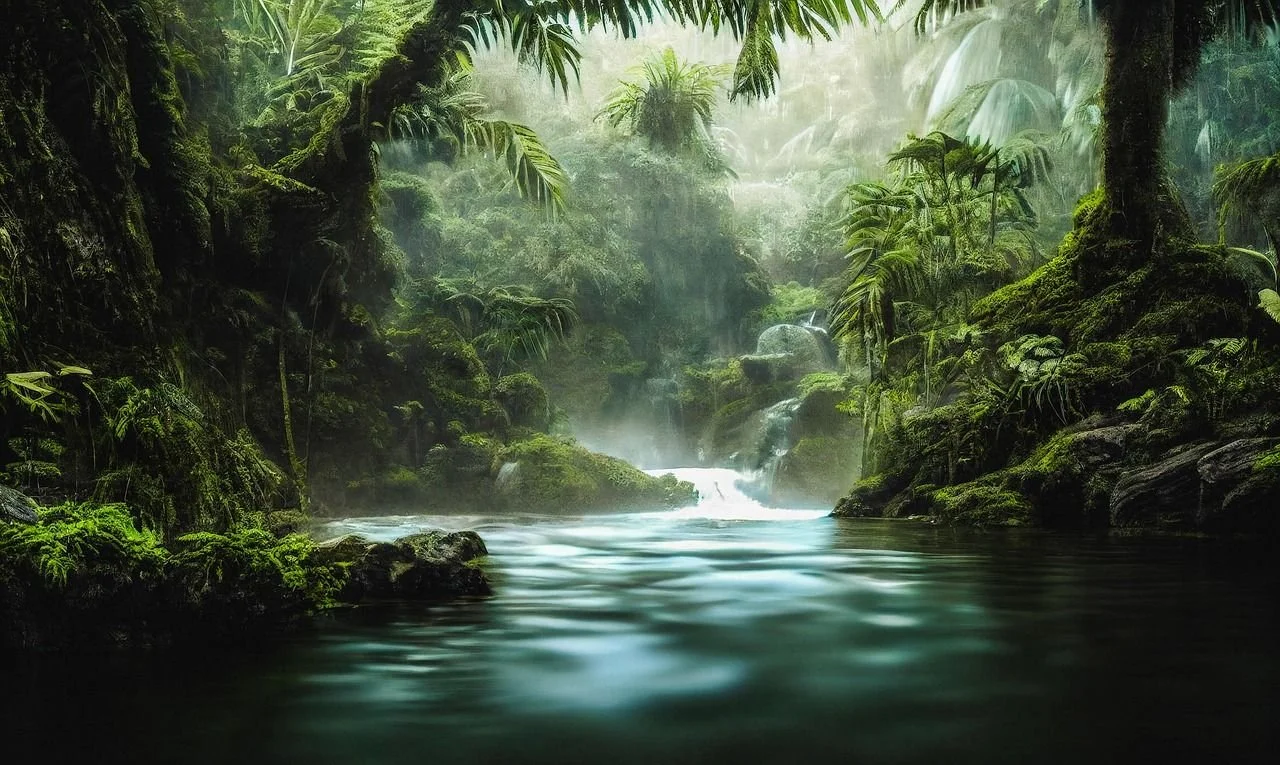
Visiting the Auca - 1979
The canoe began to turn around sideways against the flow & pivoted against some logs. Suddenly the water took control & swamped into the boat which quickly sank low into the river.
From Pilgrimage to Peru
travel journal excerpt, Ecuador, 1979:
An unplanned descent into the jungle: strangers, storms, and the river that nearly took us —>
Jueves 15 de Marzo - Mishualli [sic] Misahuallí
Meeting the Québécois
… Met some Quebecuas [sic] Québécois planning to do a jungle trip tomorrow, so I decided to join them.
Downriver Into the Jungle
Viernes 16 de Marzo - Mishualli
Packed up my little day pack, with avena, soups, chocolate, biscuits, camera, etc. and joined forces with the 3 men from Quebec.
We began the journey to visit the Auca Indians at about 9 am, journeying down river for about 1½ hrs. Then we took off on a very long walk through the jungle, crossing streams on logs & dodging a lot of mud. There were quite a few hills & muddy slopes to climb. It rained a little but the tall trees afforded a lot of protection from the shower.
Dynamite, Fish, and a Jungle Shelter
We arrived late in the afternoon at a shelter near the river. Julio, our guide, prepared a bunch of dynamite and then exploded it in the river. The guys swam & fished out 13 fish, including one piranha.
Julio cleaned & cooked the fish in a big bowl over an open fire, with salt and lemons. Very bony but tasted good. Drank coffee & then slept on the bamboo slats of the shelter.
Borrowing the Queen’s Canoe
Sabado 17 de Marzo
Cooked some oats for breakfast & had the rest of the fish & rice. As we were about to leave 3 Indians came walking of the jungle. They devoured the remainder of our meal - obviously very hungry.
The Queen of the Auca village had gone to Quito for talks & left her canoe tied to the bank near the shelter. Julio offered us the alternative of walking 3hrs to the Auca Village - that of borrowing the ‘Queen’s’ boat & floating downstream to the village.
We took this option & had a very pleasant journey cruising down the river. At one point however the rapids & current pulled us quickly into some low branches. Julio jumped out of the boat while I fought against the branches. We pulled ourselves out, but with a few scratches & marks.
A little further on we left the canoe beside the bank & walked the last hr to the village.
Unfortunately, we discovered that almost the whole tribe had gone away to a feast at another village, 4 hrs walk away. There were only a few remaining Indians, some kids & mothers with babies.
We made ourselves at home in one of the huts made of bamboo & palm thatched roof. There was a good open fire arrangement raised above the floor, pots & metal pipes for resting them on. We cooked up some soup with noodles to regain some energy.
A Cold Night on Bamboo
Slept on the bamboo floor of the house, only on my plastic ground sheet & with cotton poncho for cover. Unfortunately, it became quite cold in the night, and I really needed my sleeping bag.
Domingo 18 de Marzo
Six Hours in the Selva
Walked off with 3 Indian boys into the jungle (Selva) to hunt for birds or animals. Seven of us (incl. 3 Quebuas) crunching thru the jungle was enough to scare aware any animals, but the Indians had attempts at stalking & shooting birds with their long blow pipe. They also took a gun with the bullets we supplied but didn’t use it.
We walked on and on further away from the village & eventually began to circle back but leaving the trail and hacking our way through the trees.
Then came the kill. Two parrots fluttering in the tree tops were shot down with the blowpipe, and then the boys macheted down a tree containing the parrots nest.
As soon as it fell the boys rushed to the trunk and extracted two baby parrots alive, but crawling in ants. The ants seemed to have built a nest around that of the parrots, or something like that. Anyway the birds and the boys were covered with ants, and they spent a few anxious moments hurredly picking them off. They wrapped the birds in a leaf basket to carry easily.
Our walk lasted 6hrs altogether, much longer than we expected or wanted, but it was an incredible experience, to witness their hunting methods first hand.
Flooded Rivers and the Sinking Canoe
Lunes 19 de Marzo - Auca Village
The night was full of thunder and lightning and solid rain, also very cold again. The Queen was returning this day and so we had to get her boat back to where we found it.
Unfortunately all the streams and rivers were flooded, swift and muddy. A small stream we waded through just before the village when coming in, had now risen to such an extent that we couldn’t cross. Julio went back & fetched an Indian with a canoe to ferry us across. One by one he skillfully took us across to the other side, crossing only by using his pole.
We sloshed on to the larger river & began an impossible mission to take the canoe upstream. For two hours or so Julio, myself & the 3 French Canadians fought against the torrent, pulling ourselves upstream by the branches & logs near the banks. We used bamboo poles where the water was shallow enough but found it very tough to move the canoe against the current.
Every so often we would lose control & be dragged out into the middle, & float back, ending up on the other side. Some of the branches were spiny and thorny & prickly, which posed another danger for us as we scraped under the branches. At the same time the rain was pouring down, & so we soaked from all directions.
The ultimate moment came when we were in the middle of the river attempting attempting to make some headway against a very strong torrent. The canoe began to turn around sideways against the flow & pivoted against some logs. Suddenly the water took control & swamped into the boat which quickly sank low into the river.
We hopped out & stood waist & chest high in the rapids, holding onto the boat & our luggage & maintaining a hold of the logs and branches to prevent everything & everyone from going downstream. Our aluminium bailing bowl raced away in the water but luckily our luggage stayed in the canoe.
We tied the front of the canoe to a log & branches and then began bailing the ship with our hands & Julio’s gumboots. Julio opened his pack & pulled out, amazingly, one dry packet of cigarettes, so I had to sit through a smoke session in the middle of el rio as the torrent was racing all around us. This was certainly the turning point, which convinced Julio to return us to the village. We returned all the way, down stream back to the Indians.
Waded ashore & then proceeded to dry out over the fire. My pack was soaked & although most things were inside a plastic bag, water still got in (probably through the hole in the bottom). Most dissapointing was the fact that water entered my camera & upsetting the electronics.
I sat almost naked over the fire trying to dry the cotton poncho. In the village two other Gringos had arrived as well. Robyn from USA & her German travelling companion. We had more hot soup and coffee.
Trading With the Auca
We had a trading session with the Indians. It began when little kids began to hang around the door & shyly held up pig’s tooth necklaces. I took one and in exchange offered my biro pen.
Later a guy produced a super little blow pipe, with the arrow container, piranha teeth & wool for arrows. I fished out everything I could find for the exchange. A fork & spoon, some shells, a bullet, a chocolate bar, some coins - todo.
The Indian seemed happy with these items, and handed me his blow pipe. All was well. The French Canadien guys also did the same, for blowpipes. One boy took interest in my hat, and produced a squirrel tail for it. For another pig’s tooth I exchanged my salt container & a box of matches.
The Long Walk Back Toward the Shelter
Martes 20 de Marzo
We payed 100 sucres for some Aucas to take the canoe back for us. Fortunately it rained no more during the night & the river was beginning to drop.
We waited around until about 1pm before setting off to the shelter - this time by foot. In the meantime, the Queen returned in the boat with a small entourage, plus 2 more Gringos, an English guy & another French Canadien. She was very ordinary, wore a watch & had a transistor radio going. The Indians also tryed out a chain saw (petrol driven) and were sawing down everything in sight after they managed to get it going.
Our return to the shelter took only 2 hours. When we reached the river, Julio made another dynamite package & blew up the water - but this time no fish.
I waded through the river (up to my waist) and was happy to be on the right side of it. Two American girls were resting at the shelter - they couldn’t make it any further. We all combined forces for an evening meal of delicious rice and lentil soup, with garlic, onion, carrot etc.
Fast March to the Río Napo
Miercoles 21 de Marzo — Somewhere in the jungle —> Mishualli
Had a filling breakfast of oats, lemon tea & a little rice & tinned sardine.
We walked out to the Rio Napo, together with Robyn, the German & also their guide who carried two macaws on a pole over his shoulder. Julio led the pace, which was fast.
Including a couple of long rest stops, we reached the Rio Napo in 4½ hours. Ate bananas at a house by the river, waded across another tributary & then began flagging down upstream canoes.
After a short time we were all seated in a large, motor powered canoe heading for civilisation again - back to Mishuallli. It was great to get back, Have some comida, cerveza, warm clothes & a soft bed for the night at Residencial Negrito - where Julio operates from.
Somewhere in the jungle I left my plastic rain poncho - not worth much but very useful in this part of the world.
—————————————
The Thread I Didn’t Know I Was Following
Somewhere, between the shelter, the dynamite, the waist‑deep crossings and the long walk to visit the Auca, a thread was pulled tight — a thread I didn’t yet know I was following.
These days in the Amazon jungle were not the climax of anything; they were part of a different kind of journey, the kind that tests you quietly before revealing what it’s preparing you for.
Only months later, standing on the deck of a gleaming white reefer ship called Tropical Moon, did I recognise the same invisible current — the sense of being carried toward something I had dreamed long before I knew how to name it.
El Ceilbal - Guatemala
Pilgrimage to Peru - a travel diary 1978 - 1979
The Lure - mythical monasteries of Lago Titicaca, lost cities in Peru …
Long before I ever set foot in Peru, the journey had already begun. In the mid‑1970s, when I was still in my early twenties, a slim metaphysical book found its way into my hands — The Secret of the Andes. I didn’t know it then, but that book planted something in me. Not an idea, not a plan, but a direction.
It spoke of hidden sanctuaries high in the Andes, of ancient wisdom preserved in places that existed half in this world and half in another. It whispered of Lake Titicaca — not as a tourist destination, but as a place of mystery, a place where something waited. I couldn’t explain why it affected me the way it did. All I knew was that it stirred a longing I had no language for.
Looking back, that was the moment the thread was tied — the quiet pull toward a landscape I had never seen, a culture I didn’t yet understand, and a destiny I couldn’t have named. I didn’t think of it as destiny then. I just felt compelled.
So I bought my one-way flights. Christchurch to Auckland. Auckland to San Francisco. And from there, the long overland road through Mexico, Central America, and down the Andean spine toward Peru.
People may have assumed I was travelling for adventure. But the truth is simpler and stranger: I was following something that had already begun inside me years earlier — a summons I didn’t fully understand, but couldn’t ignore.
That is the real reason I went to South America.
The First Page of the Journey
I still have the diary I carried with me — a ruled Mexican exercise book with three carved stone figures on the cover.
On the first page, in the careful lettering of a young man trying to name something he didn’t yet understand, I wrote: PILGRIMAGE TO PERU.
Puebla, Mexico - December 1978
“This story should begin in Puebla, for it is here that began the adventures and moments of travel that are characteristic of being free‑floating in the world. To travel is to live, and to be alive in the protoplasm of the planet. It is to experience the unity and quality of life.”
Reading those lines now, I see a truth I couldn’t have articulated then: the pilgrimage had already begun.
Even before I reached Peru, before the jungles of Ecuador, before the long road south, something in me was already moving toward the Andes — toward the lake, the mystery, the call that had been planted years earlier by The Secret of the Andes. I wasn’t just travelling. I was answering something.
Constable John Gillespie
I am descended from a Scottish immigrant - a John Gillespie - who voyaged to the other side of the world in the late 19th Century.
My great‑grandfather, Constable John Gillespie became a pioneering policeman in Palmerston North, New Zealand, in the late 1800s.
In the district’s early records, one line captures his character: “zeal, energy and thorough impartiality ever displayed by Constable Gillespie in the discharge of his duties.”
He built a large family home — a house that still stands today on a road now called Gillespie’s Line— and raised twelve children as the young settlement grew around him.
I carry his surname, and I’ve always felt a quiet connection to him. Perhaps that instinct for stepping beyond the known, for moving toward the edges of the map, is something that travelled down the generations.
Leaving a legacy
And now, nearly fifty years after my own journey through the Americas, I find myself reconstructing it digitally — building a bridge that one day my great‑grandchildren may cross, just as I once reached back to him.
Guatemala 1979
By the time I reached Guatemala in early January 1979, the journey had already taken on its own rhythm — border crossings, long roads, small towns, and the slow drift deeper into Central America. I was moving day by day, often without knowing exactly what lay ahead, guided mostly by instinct and the simple momentum of travel.
This diary excerpt covers four days of travel in Guatemala — beginning with river travel, then a solitary hike through the jungle to reach a hidden Mayan temple, and finally the onward road toward Tikal in the north.
— • —
Pilgrimage to Peru - The Diary - 10th Jan 1979 to 13th Jan 1979 (4 days)
Miercoles 10 Enero 1979 (Wednesday 10 January 1979) Sebol —> El Pato
A River of Passion?
This morning I caught my first glimpse of the Rio de la Pasion. At Sebol the river is a strong flowing, muddy affair. There were several cayucos tied to stumps on the sloshy river bank. Jörn & I left on a large cayuco which also carried another canoe across the front. We did not have time or opportunity to prepare for the trip with food supplies but just carried on.
So where are the crocodiles?
It was quite an incredible feeling beginning the ride on the river - my first through jungle of any type. I began scanning the banks and river for crocodiles & other such wildlife, but it turned out that the river was pretty tame. The most I saw were birds, some lizard type animals perched on branches overhanging the river & hundreds of tiny fish everywhere in the river. They seemed to hang around the boat waiting for throw overs.
Riverine life
The river was much more civilised than one would imagine. There were haciendas & villages regularly along the river. Instead of tigers & crocodiles there were cows, horses and police checkpoints. At one point the boat was run into a muddy bank and everybody had to get out & show their passport or papers to some soldiers who made out they could understand all the documents.
Arrival at El Pato
The boat arrived at El Pato about 3pm. We payed our Q2 which seemed a reasonable regular fare that everyone had to pay. The boat owner insisted that we join him for a beer at El Pato so we stood at a tienda and drank a bottle.
A well‑worn Gringo route
It quickly became obvious that the Rio de la Pasion was a well known Gringo traveller’s route. At El Pato we joined two other German guys & two Swiss girls who waiting for further transport down the river. In the morning of the same day six others had left on a boat they had negotiated.
The Gringo encampment
The Gringo encampment was an open, thatched roof building in a plot of land surrounded by a barbed wire fence. This was a hammock swinging place, but for me I had to sleep on the ground, with my sleeping bag on top of my groundsheet (plastic rain poncho).
Comedor in the village
I walked around the village of El Pato and ended up at a comedor of sorts. I asked for a meal & received some nicely cooked beans, and eggs, tortillas & coffee. Spoke with a friendly girl from Belice who spoke English. Her husband had brought her to El Pato, where she was lonely & missing Belice.
Macaroni and drunk visitors
Later in the evening I went out to eat again with Jörn & one of the Swiss girls. We went to the regular comedor & dined on macarroni. Sat around a fire back at the hut & talked with Jorn. Later in the evening we had to deal with a group of very drunk men who came nosing over, but were quite amiable - just drunk.
Jueves 11 Enero 1979 (Thursday 11 January 1979) El Pato —>
Waiting for a boat to Sayaché
Woke up early and took watch on the river for a boat leaving for Sayache, the town that connects to Flores by road. No sign of boats so resigned to having a relaxing day at El Pato, catching up on my reading and writing. Still waiting for a spell of non-costing time for learning Spanish.
Breakfast and travellers’ tales
Had breakfast of frejoles y huevos back at the comedor & read a travellers book there. Some pitiful stories about how long folk had been stuck in El Pato & how terrible things had been for them. But I was enjoying it.
Draughts — El Pato style
In the afternoon the tienda conjured up some fresh sweet bread. They also sold juices in cans, sweets, salt biscuits, etc. Played draughts El Pato style with two kids at the tienda. Soon caught onto their rules which gave an interesting challenge to the game. the king or crown was obtained in the normal manner, had powers of movement & taking more akin to the Queen of Chess. It could zoom up a diagonal, jump a piece, and land anywhere on the diagonal. It could also switch direction and do a right or left jump (a second one) on the other diagonal, if there was an opponents piece to take. I won the first game that I played with one boy which I think impressed them quite a bit. Then we had a draw & finally he bet me back. They both played very well.
Unexpected departure
As I was getting engrossed in the game and about to consume a beer, a cayuco arrived at El Pato (The Duck!) with a load of Gringos going upstream. But the boat owner was heading back to Sayache and agreed to take all of us (6) for Q4.50 each. So at 5pm we hurriedly packed & left El Pato.
Moonlit journey down La Pasión
We motored down the river into the dark moonlit river. For me and Jorn it was to be a very quick journey down La Pasion compared with the stories of some other travellers, who had been stuck at El Pato or somewhere for days on end, waiting for a boat.
Candlelit meal on the riverbank
We were all off loaded at some house on the river bank. After sloshing our way up the bank and through the trees in the dark, with our packs we made ourselves comfortable on the porch of the house. We were served some eggs and beans and ate by candlelight.
Sleeping on the porch
After borrowing my last candle the Germans decided to play amongst themselves some card game very similar to 500. I slept on the mud floor of the porch.
Viernes 12 Enero 1979 (Friday 12 Jan 1979)
RIO DE LA PASION —> EL CEIBAL [small sketch of a Mayan temple at El Ceibal]
The riverside trader
An excellent day slowly cruising down stream towards Sayache with the same boat we started off on last night. The owner was a kind of riverside trader and he made frequent stops at villages & just houses on the bank to sell, biscuits, potatoes, tomatoes, beer, softdrink, chicles. He also transported sacks of corn, rolls of barbed wire and one hen which really suffered from being trodden on. At one stage the hen decided to go for a swim & just about strangled and/or drowned itself until I lept over to rescue it. We diverted up a tributary for 1 km to trade with an interesting village up there. Talked a bit more with Ana & Kathy on the boat, the two Swiss sisters. Spent some time practicing Spanish.
The night before Ceibal
The Mayan ruins of El Ceibal were about 25km before Sayache and I decided to leave the boat & walk to these ruins. All the others changed their minds due to the uncertainty of getting back to Sayache, I think. Anyway I climbed out of the boat beside some thick mountainous jungle in the dark and said Adios. I was going to walk to the ruins along whatever kind of track existed, but in the dark of night that would have been impossible.
I slept the night on the floor of a little house right by the river. There was an older man, his wife & a son (possibly) living there. They gave me a small piece of fish in a soup, which tasted very good, and some coffee. I tryed to communicate a little but it was difficult for us to understand each other. My night was disturbed by many mosquitos and was rather uncomfortable. Woke up with a tick imbedded in my forehead and had to snap it off.
Sabado 13 Enero 1979 El Ceibal —» Sayache
Alone among the ruins
Early in the morning the man at the house led me away through the trees and across his paddock of maize and through a jungle track up a hill, in the direction of las ruinas del Ceibal. I gave him a quetzal for his hospitality and walked off into the Gautemalan jungle, alone and happy.
Followed only by the mosquitos I carefully walked through the trees and vines making sure not to go off the narrow track. I came eventually to a wider track of road size proportions, chose to go in one direction & walked for some time in the mud.
Finally it happened ! It was a tremendous sense of achievement and discovery. A large green mound appeared on my left and then unfolded the view of a stone temple and magnificent carved stone stela.
It was as if I had discovered the ruins myself for the first time, and having journeyed for so far by river & walked through jungle just added so much to that sense of discovery.
I was excited. Here I was alone amidst some incredible structures that had been lost to the jungle by an intelligent civilisation centuries & centuries ago.
I headed for the most outstanding temple, which had been cleaned of growth and the jungle had been cleared away as well. Climbed to the top and put down my pack against the temple. I then went on a discovery mission with just my camera, climbing up a few other overgrown temples and standing awestruck in front of beautifully carved and preserved stellae.
It was almost a religious experience when I contemplated the people who lived here and built these temples.
The sacrifice?
There were a few huts of modern man & 3 men walking around. After spending an hour or so alone amongst the ruins I went to say hello to these caretakers. I signed their visitors book, which had recorded a surprising number of tourists but I seemed to be the first New Zealander since May 78.
They told me about a circular temple in another direction so I went off to find that. A large flat surfaced structure with some kind of sacrificial stone in the front. I took a time-exposed photograph of myself on the stone.
Back to civilisation
There was no town and no traffic leading away from the ruins, only a dirt road. I was told that there were buses or something at a town 7km along the road, so pack and all I walked for the 7km along a reasonable sort of road. Only had to tread carefully to avoid the armies of ants carrying leaves across the road.
I eventually walked up behind a police checkpoint. I surprised them somewhat as they weren’t expecting anyone to walk in from behind, but they were quick enough to want to see inside my pack. I opened it up, they had a fish around & that was enough. I walked on until I spotted what looked like a possible comedor. It was! Quenched my thirst with two hugos, then ate some scrambled eggs.
Walked on another km and came to a tienda where a few chaps were waiting for a camion. Eventually I got a ride in the back of a Toyota van to Sayaché. Went to a hotel and rested up. No water but at least a comfortable bed. Ate beans and eggs with an American couple.
<><><><><><><><><><><>
That’s one small step for man, a giant leap for mankind; mankind went to the moon almost 50 years ago (1969) then returned (Artemis) in 2026!
My journey to and through South America was almost 50 years ago too; and now I have returned. This time I haven’t returned physically but I have returned in my mind.
I have reopened the door to my past.
The dust has been blown off my travel journal of 1978/1979. It has revealed who I was as a young traveller. I feel almost exhausted, not by reading or transcribing it - I feel an imaginary exhaustion from simply reading my own story - about how energetic I was at the age of 23; trudging through the Guatemalan jungle - alone with the jaguar and snakes - with the potential of getting lost - carrying a heavy pack, climbing Mayan temples that I have discovered in the heart of the jungle - temples that are still just green mounds, not even excavated.
The Guatemala segment is part of a wider journey; a journey of 11 months in the Americas, but mainly in Mexico, Central America and South America. It takes me as far south as 53 degrees latitude, in the middle of the Magellan Strait, with Tierra del Fuego on one side, Chile on the other.
There is a theme to all of this travel; a spiritual quest. It’s complex, as these things often are. On the one hand I long to catch a ride on a cargo ship, on the other I am drawn towards Peru to discover either a lost Incan city in the jungle, or a mythical monastery at Lake Titicaca - or both.
It’s a perfect journey. Despite travelling solo I am never alone; there are new friends to be made all along the journey.
Looking back, from the perspective of 2026, I now realise that my journey matches very closely those of the young shepherd boy in Paulo Coelho’s classic story - The Alchemist. This story is one of being tested by the Universe. A story of following your dream. When you really, really want something, all the Universe conspires to help you.
<><><><><><><><><><><>
More of this story unfolds in Ecuador: I trudge in to the Ecuadorian jungle to visit an Indian tribe known as the Auca. It turns out to be a risky trip as I get caught out in a flooded river and almost come to grief.
Later I reach Uruguay and from there another adventure unfolds - voyaging on a banana boat all the way back to Ecuador.
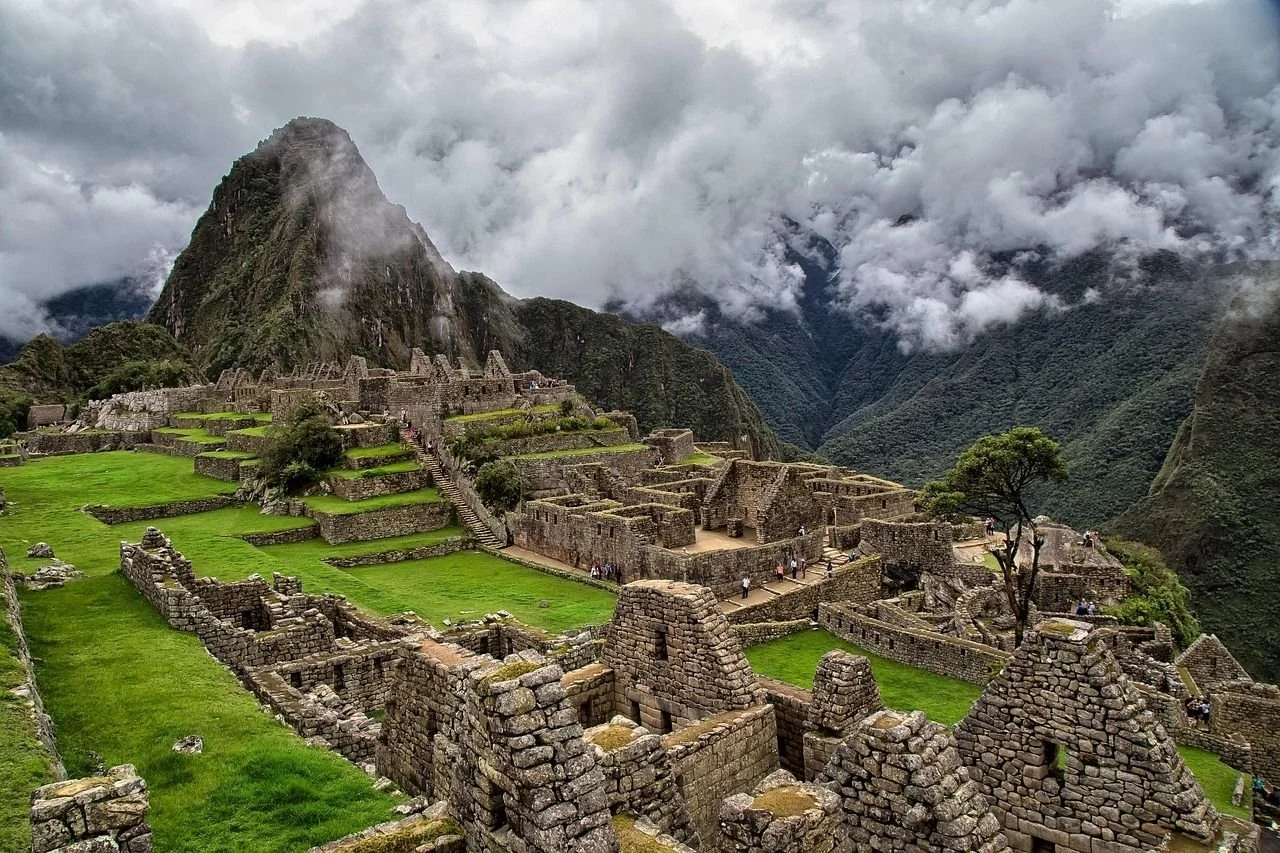
Machu Picchu
sunrise over Machu Picchu - climbing the mountain in the dark
Walking through railway tunnels
Viernes 18 de Mayo, 1979 - Machu Picchu
At 5:10 am I began walking to Machu Picchu, starting off along the railway line from Aguas Calientes.
I went with the Californian & a Swiss guy. There was enough light from the stars & half moon coming through the patchy clouds, but our problem was passing through two very dark railway tunnels.
We managed by setting fire to some toilet paper & using my box of matches. Around us we could distinguish the towering shapes against the sky. They were incredibly huge & abrupt from our position close to the Urubamba River.
Climbing Machu Picchu
We ascended a hill in the dark, following a steep track. It was becoming lighter and lighter. The track crossed the road several times, but it was quicker than taking the zig-zag graded road.
About 6:30 am I began to see terraces & rocks on the side of the ridge - this was Machu Picchu.
Machu Picchu for sunrise
I entered the gate & quickly climbed to the highest part of the ruins, in order to catch the sunrise over the peaks.
I reached the hut at the top by about 6:40 am and in the company of a handful of Gringos, some of whom had slept in the hut, waited for the sun to pop over the mountain.
It occurred about 7:05 am but it was already well light. However it was a great opportunity to capture the great view of Machu Picchu on film in the soft early morning sunlight.
Exploring Machu Picchu
I walked around the ruins, exploring almost everything. Saw the partially split rock still with wedge-shaped cuts hammered in to form a crack.
Bought a ticket for the ruins 100 sols with student card (otherwise 750 soles) and then went to the Machu Picchu hotel for breakfast. 400 soles ripoff breaky, but where else can you eat so close to one of the most famous structures in the world.
Went back to the ruins and who should I run into, but Monika. She and her 3 German friends from Huancayo had just finished walking the Inca Trail.
About 11 am I saw tourists beginning to arrive from the early morning Cuzco train, so I headed up to Huayna Picchu, the towering granite peak that looks down on Machu Picchu. Great views in all directions, of the river, Machu Picchu & the mountains. Walked down and took more photos amongst the ruins ; One of the Intihuatana rock, the sculptued sun dial; one of the altar-rock in the Temple of The Sun.
Back to base camp - Aguas Calientes
Came down the zig-zag road on about the last mini bus (150 soles) and then walked back to Aguas Calientes along the rail track.
Went to the hot pools for a bath but the water was very dirty. Had soup, chocolate & beer with Monika & the Germans. Feel asleep early as I was very tired from all the day’s walking & climbing.
Quillabamba
Sabado 19 de Mayo Aguas Calientes —> Quillabamba
Took the train to Quillabamba. It came through at 10 am & I travelled comfortably down the Rio Urubamba into the tropical lands of the Selva, otra vez.
Transferred to large van cum taxi which ferried a mob of us up the hill to the Plaza de Armas.
I found a hostal, locked up my pack & then explored the town. Nothing very exciting at Quillabamba. It is probably a good base for more jungle expeditions & journeys into the interior, but I was not in the mood for anything too adventurous.
Looked around the concrete market. Ate there in the evening from one of the instant, cooked-before-your-eyes stalls. 50 soles for 2 fried egg on top of rice, with nice hot cooked cabbage, tomato, etc. Wrote a letter to Terry.
[the above is an excerpt from my travel diary of 1979 - Pilgrimage to Peru]
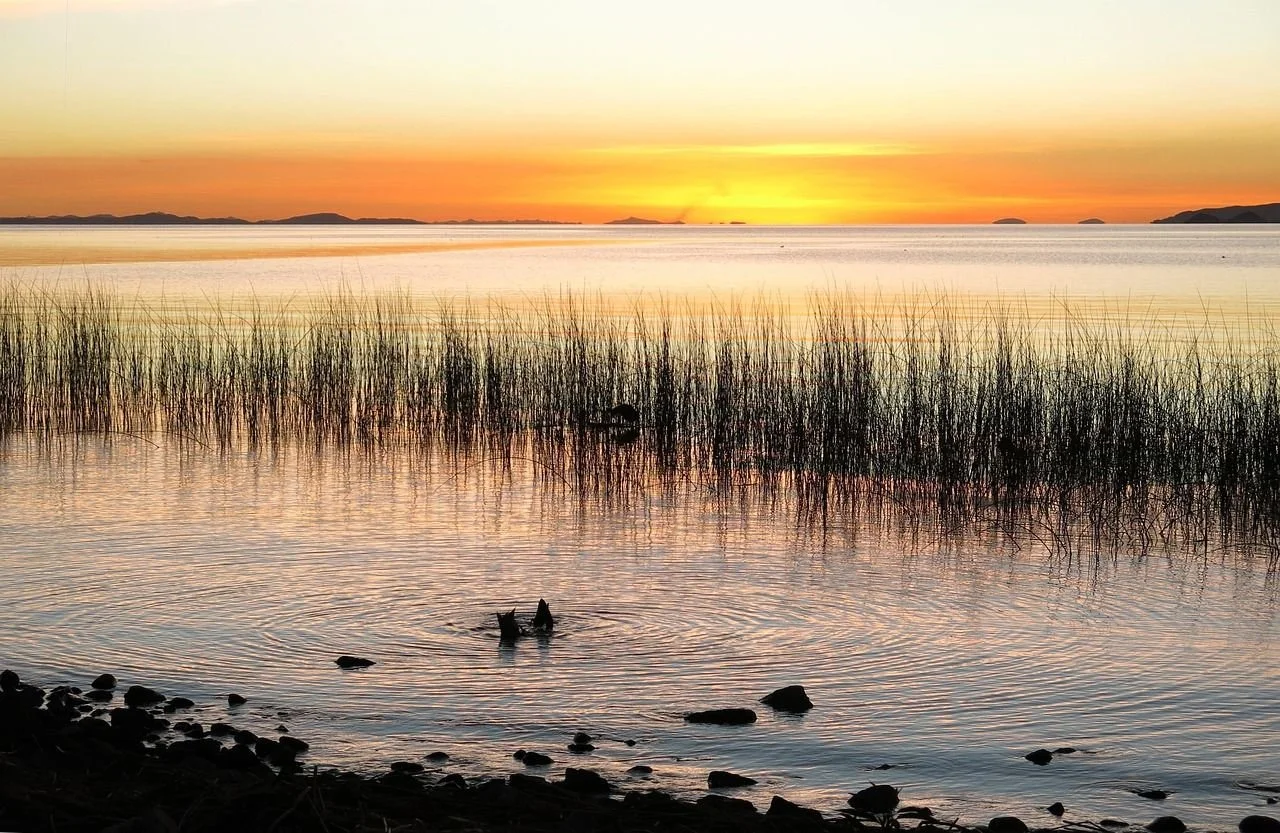
Pilgrimage to Peru
In search of a mythical monastery at Lake Titicaca
How travellers travelled in the 1970’s
Long before smartphones, apps, tiktok and insta, long before wifi, whatsapp, before the internet, before personal computers, travelllers travelled. They had fold-out maps, poste restante, and the travellers’ grapevine.
The Gringo Trail
This was the age in the 70’s when I embarked on a grand adventure taking on the Gringo Trail - moving south from country to country, through Mexico, Belize, Guatemala and El Salvador, skipping across to Colombia and then moving down the spine of South America - the Andean countries, and eventually reaching Argentina and Uruguay.
Dear Diary - Pilgrimage to Peru
I kept a diary - a very detailed diary, day by day, on what I had for breakfast, the cost of things, who I met and how I got around.
Looking back now, some 50 years ago, it is a window to a different age. Some things haven’t changed, like meeting fellow travellers along the way - somehow running into those same people again, further along the trail.
The Travellers’ Grapevine
We left notes for each other. We wrote letters and sent them ahead to a post office in Quito, or Lima. We cashed travellers cheques.
The Path
My journal is titled Pilgrimage to Peru - it’s now an historical record of one young man’s search within, following a path that is to become a spiritual journey.