
Doofs - Australia and beyond
It All Begins Here
The "Social Contract" of the modern era—the 9-to-5 desk, the 30-year mortgage, the stationary life—is, in the grand timeline of humanity, a very recent and perhaps unnatural experiment.
For the vast majority of our history, to be human was to be a traveler.
This is not a metaphor; it is written in our DNA and etched into the map of our world.
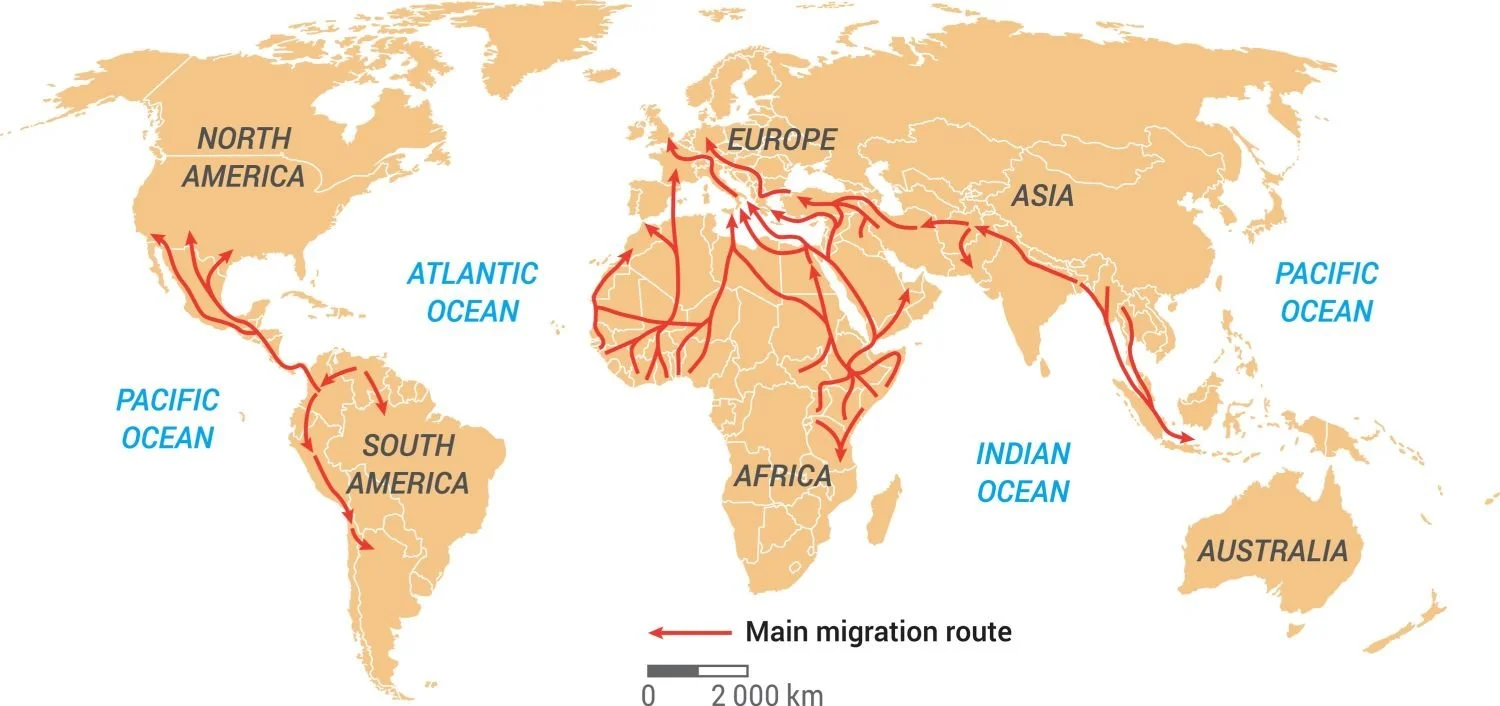
1. The Great Leap: The "Out of Africa" Legacy
Approximately 62,000 years ago, a small group of humans—perhaps only a few hundred individuals—made a monumental decision.
They crossed the Bab-el-Mandeb (the "Gate of Grief") at the mouth of the Red Sea.
This tiny genetic population carried with them the curiosity and the resilience that would eventually populate every corner of the globe.
They didn't have maps; they had the DRD4-7R "Wanderlust Gene."
This variant, linked to novelty-seeking and risk-tolerance, was the engine of our survival.
As they moved along the coasts of Asia and into the Sahul (the ancient continent of Australia and New Guinea), they established the first "travel routes" in history.
When you feel a restless urge to see what is over the next horizon, you aren't just "bored."
You are hearing the 60,000-year-old echo of those first pioneers.
2. The Lineage of Dissent: From Hippies to Technomads
The modern rejection of the "9-to-5" is simply the latest chapter in this story.
The 1960s Spark: The Hippy culture was the first modern "mass dropout" event, a collective memory-jogging of our nomadic roots.
Goa and the Birth of Trance: In the 1970s and 80s, the "Hippie Trail" led to Goa, India. Here, the acoustic wanderer met the electronic pioneer. Goa Trance became the digital folk music of the neo-nomad.
Technomadism: Today, the "Technomad" uses high-tech tools to live a low-impact, high-mobility life. Why own a house when you can own the horizon?
3. The Architecture of the "Doof": Communitas and Liminality
Across the globe, this "itch" manifests in temporary, high-energy gatherings often called "doofs" or festivals. These aren't just parties; they are sociological phenomena.
Liminality: The state of being "between" worlds. In a festival or a nomadic caravan, you are no longer your job title or your bank balance.
Communitas: This is the intense social bond formed when people exist as equals. Whether in the dust of an Australian Bush Doof or a forest in Portugal, it is a return to the "tribe" of our ancestors.
Temporary Autonomous Zones (TAZ): These are spaces where the standard rules of society are suspended, allowing for radical self-expression and connection.
4. A Global Map of the Modern Nomad
The Southern Cross: Australia and New Zealand
The Bush Doof: In Australia, the "doof" is a rugged, neo-tribal ritual. It is a high-energy gathering that honors the ancient, harsh landscape through electronic pulse and collective movement.
NZ House Truckers: In places like Golden Bay, the New Zealand house-trucker culture proves that "home" is a mobile sanctuary of wood and brass—a literal rejection of the mortgage.
The Americas: Combi Cities and Sacred Grounds
The "itch" manifests with a unique intensity in Latin America, where the landscape itself—from high deserts to dense rainforests—dictates a life of constant adaptation and movement.
Brazil's Nomadic Cities: The "Kombi" (VW bus) culture in Brazil has birthed rolling neighborhoods where travelers share kitchens, stories, and the road.
This is a modern, motorized version of the ancient caravan, proving that community isn't defined by a postcode, but by a shared perimeter.
The Mexican High Desert: Real de Catorce: In the semi-arid highlands of San Luis Potosí, the "itch" leads travelers to the ghost town of Real de Catorce.
Here, neo-nomads gather in the dust to seek clarity. It is a place of pilgrimage where the silence of the desert serves as a backdrop for deep introspection and the rejection of the "noise" of modern consumerism.
The Forest Parties of CDMX: Just outside the sprawling urban density of Mexico City, the forest becomes a sanctuary.
High-altitude "forest parties" serve as a pressure valve for the city’s inhabitants. Beneath the canopy of the Ajusco or Desierto de los Leones, the electronic pulse of the nomad meets the ancient spirits of the woodland, creating a temporary autonomous zone where the city's rigid hierarchies simply melt away.
The Central American Jungle Doof: Moving south, the movement takes on a humid, emerald hue. In the jungles of Central America, the "Doof" culture adapts to the rainforest.
These gatherings are characterized by "low-impact, high-immersion" philosophies.
Costa Rica’s Envision Festival: This is perhaps the pinnacle of the modern Latin American pilgrimage. It isn't just a festival; it’s an experiment in "Permaculture, Spirituality, and Movement."
The Jungle Sanctuary: In the heat of the jungle, the standard rules of society are replaced by the rhythms of the sun and the tide.
It is here that the nomad learns the ultimate lesson of the "7R" gene: that to be truly free, one must be able to thrive in the wild, carrying only what is necessary and leaving nothing but footprints.
The Global Pulse: Collective Healing
The Global Pulse: Collective Healing If the "7R" gene is our engine, these gatherings are the tuning fork. They function as "pressure valves" where the rigid identity of the modern era dissolves into the rhythm of the tribe.
Israel: The Desert Catharsis. In the Negev, "post-military" raves serve as a psychological necessity. After years of high-stakes discipline, the repetitive electronic pulse provides a framework to shake off trauma and reclaim the spirit through radical decompression.
South Africa: The Dust-Heavy Stomp. In the Western Cape, the physical grit of the landscape dictates the ritual. The "stomp" becomes a communal groundedness, where kicked-up dust and ancient earth turn the dance floor into a site of raw, somatic restoration.
Portugal: The "Slow" Sanctuary. In the sun-bleached Alentejo, the "Ancestral Itch" is met with a philosophy of immersion. By favoring "Slow Travel" over a frantic escape, the nomad uses the rhythmic gait of the dance to re-integrate with their nomadic lineage.
By reclaiming the body from the "Social Contract" in these remote zones, we prove that the most profound healing happens in motion, under an open sky.
5. Dropping Out: The New Success
Choosing a van over a villa isn't "failing"—it’s a strategic pivot toward Autonomy.
The Mortgage Trap: By rejecting high-interest debt, you gain the most valuable currency in existence: Time.
The Wanderlust Gene: For those of us with the "7R" variant, domesticity is physically stifling. We aren't "lost"; we are simply calibrated for a world that requires movement.
Conclusion: The Horizon is the Only Constant
The 60,000-year-old journey that began at the "Gate of Grief" has not ended; it has simply evolved.
We have traded the star-charts of the Sahul for the digital tools of the technomad, and the tribal drum for the electronic pulse of the doof.
In a world that insists on "settling down," the act of moving is a profound reclamation of our original nature.
Whether you are navigating the high-altitude deserts of Mexico or the rugged expanses of the Australian bush, you are participating in a lineage as old as humanity itself.
The "Itch" is not a signal that something is wrong; it is a reminder that you were built for discovery.
By choosing time over debt, we aren't just dropping out—we are stepping back into the flow of history.
For the modern nomad, the destination was never the point.
The point is the movement itself. Because for those of us with 7R in our blood, home isn’t a place you stay. It’s a way of being in the world.

Small Steps Create Big Shifts
It All Begins Here
Confidence doesn’t always arrive with a bold entrance. Sometimes, it builds quietly, step by step, as we show up for ourselves day after day. It grows when we choose to try, even when we’re unsure of the outcome. Every time you take action despite self-doubt, you reinforce the belief that you’re capable. Confidence isn’t about having all the answers — it’s about trusting that you can figure it out along the way.
The key to making things happen isn’t waiting for the perfect moment; it’s starting with what you have, where you are. Big goals can feel overwhelming when viewed all at once, but momentum builds through small, consistent action. Whether you’re working toward a personal milestone or a professional dream, progress comes from showing up — not perfectly, but persistently. Action creates clarity, and over time, those steps forward add up to something real.
You don’t need to be fearless to reach your goals, you just need to be willing. Willing to try, willing to learn, and willing to believe that you’re capable of more than you know. The road may not always be smooth, but growth rarely is. What matters most is that you keep going, keep learning, and keep believing in the version of yourself you’re becoming.

Turn Intention Into Action
It All Begins Here
Confidence doesn’t always arrive with a bold entrance. Sometimes, it builds quietly, step by step, as we show up for ourselves day after day. It grows when we choose to try, even when we’re unsure of the outcome. Every time you take action despite self-doubt, you reinforce the belief that you’re capable. Confidence isn’t about having all the answers — it’s about trusting that you can figure it out along the way.
The key to making things happen isn’t waiting for the perfect moment; it’s starting with what you have, where you are. Big goals can feel overwhelming when viewed all at once, but momentum builds through small, consistent action. Whether you’re working toward a personal milestone or a professional dream, progress comes from showing up — not perfectly, but persistently. Action creates clarity, and over time, those steps forward add up to something real.
You don’t need to be fearless to reach your goals, you just need to be willing. Willing to try, willing to learn, and willing to believe that you’re capable of more than you know. The road may not always be smooth, but growth rarely is. What matters most is that you keep going, keep learning, and keep believing in the version of yourself you’re becoming.

Make Room for Growth
It All Begins Here
Confidence doesn’t always arrive with a bold entrance. Sometimes, it builds quietly, step by step, as we show up for ourselves day after day. It grows when we choose to try, even when we’re unsure of the outcome. Every time you take action despite self-doubt, you reinforce the belief that you’re capable. Confidence isn’t about having all the answers — it’s about trusting that you can figure it out along the way.
The key to making things happen isn’t waiting for the perfect moment; it’s starting with what you have, where you are. Big goals can feel overwhelming when viewed all at once, but momentum builds through small, consistent action. Whether you’re working toward a personal milestone or a professional dream, progress comes from showing up — not perfectly, but persistently. Action creates clarity, and over time, those steps forward add up to something real.
You don’t need to be fearless to reach your goals, you just need to be willing. Willing to try, willing to learn, and willing to believe that you’re capable of more than you know. The road may not always be smooth, but growth rarely is. What matters most is that you keep going, keep learning, and keep believing in the version of yourself you’re becoming.